

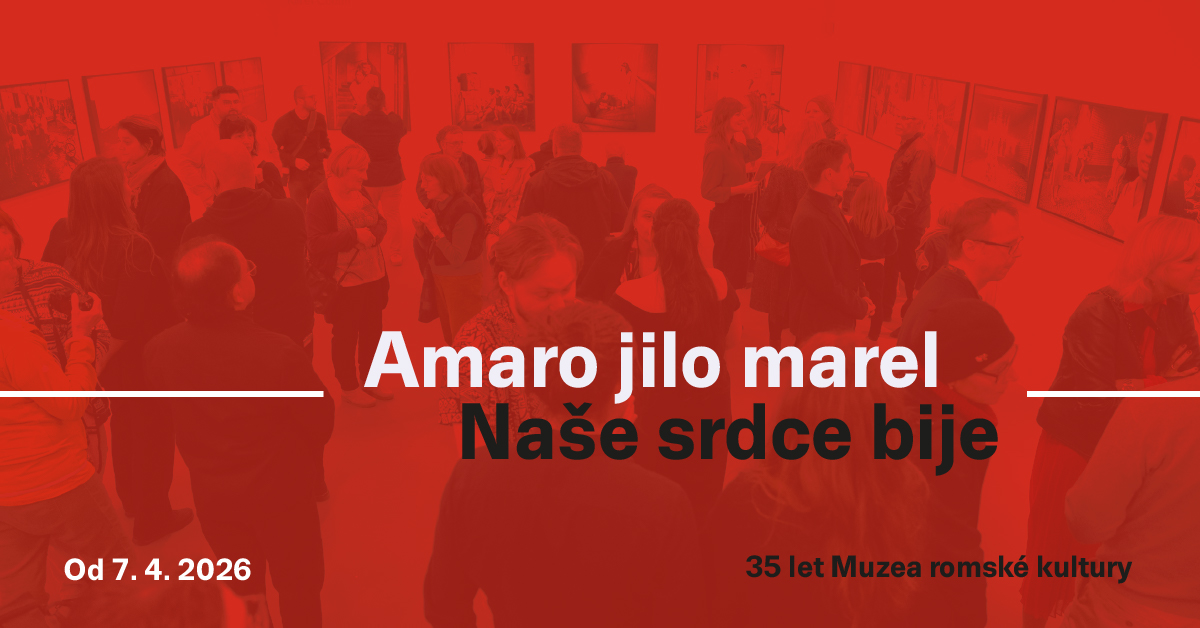
35 Years of the Museum of Romani Culture
This year marks the 35th anniversary of the founding of the Museum of Romani Culture. And it is precisely this journey—sometimes daring, sometimes challenging, but always guided by the heart—that the new exhibition *Amaro jilo marel / Our Hearts Beat* presents. We cordially invite you to its grand opening.
Through photographs and video installations, the exhibition tells the story of an institution that was founded on the initiative of Romani figures and their allies shortly after November 1989. However, the idea of a Roma museum of its own goes back even further—to 1969, when the Union of Gypsies and Roma attempted to establish one. At that time, the regime silenced the dream. But after 1989, it was revived.
On April 7, 1991, the Society for the Establishment of the Museum of Romani Culture was registered in Brno. A group of 24 Romani figures and non-Romani experts thus laid the foundations for an institution that is today a respected museum of European significance.
Since 2005, the Museum of Romani Culture has been a state-funded organization under the Ministry of Culture. It has long fulfilled its mission to be:
a space for the meeting of cultures,
a place that opens paths to the roots of Romani identity,
an institution preserving and making accessible the culture and history of the Romani and Sinti as part of world heritage.
The exhibition commemorates not only the museum’s early days in temporary quarters, the development of its collections, and the creation of the permanent exhibition *The Story of the Roma*, but also the significant expansion of the museum’s scope in commemorating the Roma Holocaust through the Memorials to the Holocaust of the Roma and Sinti in Moravia and Bohemia.
The exhibition opening will take place in the exhibition spaces of the Museum of Romani Culture, and admission is free.
1. Karel Holomek (1937–2023), politician, publicist, and co-founder of the Museum of Romani Culture (MRC), who for many years served as its statutory representative and honorary chairman of the museum society. In 1999 he founded the non-profit organisation Společenství Romů na Moravě / Community of Roma in Moravia and began publishing the Roma biweekly newspaper Romano hangos / Roma Voice, which continues to be published to this day. Brno. Photo: Marta Hudečková, 1993.
2. Bartoloměj Daniel, historian (1924–2001), co-founder of the MRC and the museum's historian, who had already begun building collections for a future Roma museum within the Union of Gypsies–Roma. Ilona Lázničková (1949–2023), ethnologist, head of the museum (1993–1995) and subsequently its first director from 1995 to 2003. Brno. Photo: Milan Hofer, 1995.
3. Poet, Roma cultural activist and editor-in-chief of the newspaper Romano kurko / Roma Week, Jan Horváth Döme (1959–2020), a long-serving specialist at the MRC. Pictured with his wife Flóra. Prague. Photo: Eva Davidová, 1996.
4. Eva Davidová (1932–2018), ethnologist, sociologist, art historian and acclaimed photographer of Roma life, co-founder of the MRC. On the right, Jana Horváthová (*1967), historian and museologist, director of the MRC since October 2003. Together on a collection-building and research trip. Detva, Slovakia. Photo: Jan Horváth Döme, 1994.
5. I.Romfest 1990 in Brno–Mariánské údolí, produced by the Brno RomArt organisation led by Milan Ščuka senior (*1947). As part of the festival, the exhibition Roma ič the adaďives / Roma Yesterday and Today was held; its creators, Eva Davidová and Jana Holomková (later Horváthová), were inspired by it to begin building the museum. In the foreground, the founder of Czech Romani studies, Milena Hübschmannová (1933–2005), in conversation with Karol Adam, musician and later director of the Košice Roma theatre Romathan. Brno. Photo: František Sysel, 27–29 July 1990.
6. The first-ever exhibition of the Museum of Romani Culture, Roma in Czechoslovakia, held at the Ethnographic Institute of the Moravian Museum. Brno. Photo: Milan Hofer, 1992.
7. The early depository of the collection of traditional Roma crafts in the provisional premises of the MRC in the former Wool Research Institute, Brno, Václavská 6. Photo: Milan Hofer, 1995.
8. Ceremonial unveiling of a monument by sculptor Zdeněk Hůla at the improvised burial site of the former concentration camp for Roma and Sinti in Lety u Písku, attended by Czech President Václav Havel. The MRC participated in the event and on the day of the unveiling organised a specialist seminar with international participation in Písek, entitled The Unknown Holocaust. Lety u Písku. Photo: Arne B. Mann, 13 May 1995.
9. The MRC building at Bratislavská Street 67 prior to renovation. Brno. Photo: Aleš Hrad, 1997.
10. Installation of the memorial to victims of the Roma Holocaust at the emergency cemetery of Žalov, near the former concentration camp for Roma and Sinti in Hodonín u Kunštátu. On the left, the author, sculptor Eduard Oláh (1955–2018); on the right, ethnologist Andrej Sulitka (*1945), head of the secretariat of the Government Council for National Minorities. Olešnice near Kunštát. Photo: Author unknown, August 1997.
11. Czech President Václav Havel and his wife Dagmar visiting the MRC, in the provisional basement depository, then located in the family house on Jugoslávská Street in Brno. The museum's collections are presented by Jana Horváthová, at the time a specialist at the museum (and current director). Brno. Photo: Michaela Dvořáková, 19 March 1999.
12. From the exhibition Rodas amaro than / In Search of Home, Anthropos Pavilion, Moravian Museum, April–October, Brno. Photo: Jan Šlancar, 1999.
13. Opening of the exhibition on traditional Roma blacksmithing, Black Craft, or There Is No Man Like a Blacksmith, which also presented collections from the MRC and Roma blacksmithing production, Ethnographic Institute, Moravian Museum. Brno. Photo: Ilona Lázničková, 2004.
14. The museum's founders in discussions with government ministers about the possibility of establishing the MRC as a state-funded museum – a visit by the Minister of Labour and Social Affairs Zdeněk Škromach to the MRC during the exhibition Social and Anti-Racist Poster (from the collections of the Moravian Gallery), at the centre of which stood a nomadic wagon, now displayed in the 2nd hall of the permanent exhibition. Brno. Photo: Magda Kucharičová, 2004.
15. E luma romane jakhenca / The World Through Roma Eyes, a long-running travelling exhibition of visual art by Roma artists from the MRC's collections; the hall dedicated to anonymous folk art was arranged as a kher – the interior of a traditional Roma dwelling. Brno. Photo: Magda Kucharičová, 2004.
16. Construction of the 5th hall of the permanent exhibition The Story of Roma, dedicated to the post-war period – the exhibition was built backwards, beginning with the most recent period; the architect of halls 4–6 covering the period 1939–2005 is Daniel Pospíšil (*1975). Brno. Photo: Magda Kucharičová, 2004.
17. Čalo voďi / Satiated Soul, an exhibition dedicated to literary works by Roma authors, prepared by the MRC's curators and Romani studies specialists Jana Kramářová and Helena Sadílková (who today heads the Romani studies seminar at Charles University). The exhibition was accompanied by a rich programme of author readings by the featured writers. Brno. Photo: Jana Kramářová, 2006.
18. Since 2004, the Museum has taken part in the festival – the so-called Museum Night every year, which offers free admission and a special programme including demonstrations by tradition bearers – folk craftspeople at work. A Roma trough-maker demonstrates his woodworking skills. Brno. Photo: Magda Kucharičová, 2004.
19. Documentation of an interview with visual artist Julius Lakatoš (1938–2009) as part of an extensive research project focused on visual art by Roma artists in Slovakia. Photo: Jana Horváthová, April 2005.
20. Ján Šariský, the long-serving custodian of the MRC building and depository and an accomplished musician, installs paintings in the 5th hall of the permanent exhibition. Brno. Photo: Magda Kucharičová, November 2005.
21. Grand opening of the first part of the permanent exhibition The Story of Roma – halls 5 and 6, presenting the post-war period up to 2005. Pictured are the museum's specialist staff and collection curators Helena Danielová (now at IQ Roma servis) and ethnologist Jana Poláková (now at the Ethnographic Institute of the Moravian Museum). Brno. Photo: Simona Šreková, 5 December 2005.
22. Fashion show entitled Luminita Dances, a presentation of historical garments and jewellery from the textile and jewellery collection, with model Andrea Balogová. Brno. Photo: Anna Juránková, 2006.
23. Crafts of Our Ancestors / Sikhľarďi buťi — somnakuňi buťi. Exhibition presenting the collection of traditional Roma crafts. Curator: Jana Poláková. Brno. Photo: Anna Juránková, 2007.
24. From 2004 to 2019, regular tutoring for children took place at the MRC, supported in significant part by the American Jewish foundation Bader Philanthropies. Pictured is tutor Petr Svojanovský (now an assistant professor in the Department of Education at Masaryk University). Brno. Photo: Lenka Grossmannová, 2011.
25. In 2008, the museum carried out extensive research in Romania focused on music and the documentation of folk crafts, in collaboration with its long-standing exhibition curator Reghina Maruntelu from the Romanian Kalderash community and American ethnomusicologist Pom Collins.
26. In 2008, the MRC hosted its first sculpture symposium as an accompanying event to the exhibition Roma Sculpture. Pictured in the museum garden, working on their sculptures, from left to right: Ivan Berky-Dušík, Jaroslav Cicko and Ondrej Gadžor. Brno. Photo: Simona Šreková, 2008.
27. The completed 5th hall of the permanent exhibition. Brno. Photo: Lenka Grossmannová, 2009.
28. Exhibition: Union of Gypsies – Roma (1969–1973). On the first Roma organisation in the Czech lands, whose legacy the MRC proudly claims as its own; curators Milada Závodská and Michal Schuster. Brno. Photo: Lenka Grossmannová, 2009.
29. In 2009, the Museum of Romani Culture Prize was awarded for the first time. Its laureate was Jana Šustová, editor at Czech Radio, who received it for her sustained support of the museum and her contribution to building its collections, as well as for her promotion of Roma culture more broadly. Brno. Photo: Lenka Mitrenga, 2009.
30. Canvases for Large Black Eyes, an exhibition of works by painter Míla Doleželová (1922–1993). Brno. Photo: Lenka Grossmannová, 2010.
31. On 1 December 2011, the final section of the permanent exhibition was ceremonially opened, covering Roma history and culture from its Indian origins through to the period of the first Czechoslovak Republic. This completed the exhibition as a whole, spanning 350 m² across an entire floor of the museum building. The architectural design is by Jan Konečný (1951–2024). Brno. Photo: Lenka Grossmannová, 2011.
32. Ball of the Decade, held on the occasion of the 10th anniversary of the MRC as a state institution. Brno. Photo: Lenka Grossmannová, 2015.
33. Exhibition Roma Treasure / Amare somnaka. The Secret of Roma Jewellery. Exhibition curators: Jana Horváthová, Jana Habrovcová, Katarína Gecelovská and Ján Šariský. The opening was attended by the then Minister of Culture Daniel Herman, who took the exhibition under his patronage; to his right, visual artist and jeweller Monika Vontszemüová; reflected in the glass, visual artist and jeweller Nicole Taubingerová and Deputy Minister of Culture Vlastislav Ouroda (1967–2024). Brno. Photo: Adam Holubovský, 2016.
34. O kosmos hino kalo / The Universe is Black, an exhibition selected from works presented at the 5th sculpture symposium and from other museum collections, curatorially conceived by artist Ladislava Gažiová as a chronological narrative of Roma art for the MRC. The exhibition was created through collaboration between two Brno state institutions, the Moravian Gallery and the MRC. Brno. Photo: Adam Holubovský, 2017.
35. Among the events held at the MRC, alongside exhibitions and lectures, was the wedding of the daughter of museum custodian Štefan Ferenc, who among other things read to the wedding guests from the Bible in the Romani language. Brno. Photo: Adam Holubovský, 2018.
36. Miri sveti / The Worlds of Andrej Pešta (1921–2009), an exhibition of photographs by this singular Roma personality gifted with many talents. Curators: Adam Holubovský and Tomáš Pospěch. A book of photographs of the same title was published alongside the exhibition. The accompanying documentary film produced by the MRC won the main prize Černý Janek at the MUSAIONfilm 2018 festival. Brno. Photo: Adam Holubovský, 2018.
37. Lavutara. Along the Paths of Roma Musicians and Their Songs, an exhibition about Roma music. Exhibition curators: Matyáš Dlab, Anna Babjárová, Zbyněk Andrš and Gejza Horváth. The accompanying programme featured countless memorable summer concerts held in the MRC garden. The museum also broadcast music programmes online via its official YouTube channel and streamed them live on Facebook. Brno. Photo: Adam Holubovský, 2019.
38. Opening of the permanent exhibition at the first branch of the MRC: The Hodonín u Kunštátu Camp: A Crossroads of Tragic Fates, 1940–1950. Central Europe. Hodonín u Kunštátu. Memorial to the Holocaust of Roma and Sinti in Moravia. Photo: Žaneta Turoňová, 2021.
39. The exhibition The Road is Open / Phundrado Drom was part of a museum project through which the MRC launched the development of its third branch – the Centre for Roma and Sinti in Prague. The curators were Petra Hanáková, an art historian from the Slovak National Gallery, and Roma visual artist Emília Rigová, who combined a gallery presentation of visual art with an open depository of the museum's collections – a showcase of the scope and diversity of its holdings. The exhibition was held in Prague at the Ethnographic Museum of the National Museum (known as the Musaion). Prague. Photo: Žaneta Turoňová, 2022.
40. Roma activist and long-standing leader of the campaign against the pig farm in Lety, Čeněk Růžička (1946–2022), at the symbolic commencement of the demolition of the pig farm. Lety u Písku. Photo: Žaneta Turoňová, 22 July 2022.
41. Grand opening of the second MRC branch, the memorial at Lety u Písku; the ceremonial ribbon is cut, from left to right, by: Minister of Culture Martin Baxa, President of the Czech Republic Petr Pavel, MRC Director Jana Horváthová, State Secretary of the Norwegian Ministry of Foreign Affairs Maria Varteressian, and Minister of Foreign Affairs Jan Lipavský. Lety u Písku. Photo: Jan Mihaliček (400 ASA), 2024.
42. In 2024, President Petr Pavel visited the MRC's main building in Brno and its exhibitions. Brno. Photo: Gabriela Eliáš.
43. Black Butterfly, an exhibition by Finnish Roma artist Kiba Lumberg (*1956), visual artist, writer and human rights activist. Exhibition curator: Veronika Lukešová. Brno. Photo: Gabriela Eliáš, 2024.
44. Opening of the exhibition We Are Here – photographs by 400 ASA photographers Jan Mihaliček (*1965) and Karel Cudlín (*1960). Exhibition curator: Simona Šreková. Brno. Photo: Petr Žemla, 2025.
45. Graffiti/spray-paint workshop with artist Ladislav Mucha, artistic pseudonym Maxim Muchow (*1984), held at Káznice Brno as part of the accompanying programme for the exhibition Romipen, which opened on Roma Resistance Day, 16 May 2025, at the MRC. Brno. Photo: Simona Šreková, 2025.
1. Čalo voďi. Author: Viktor Vokjan, 2006.
2. Crafts of Our Ancestors. Author: Anna Juránková, 2007.
3. Roma Sculpture. Author: Anna Juránková, 2008.
4. Promotional Film. Author: Anna Juránková, 2008.
5. To Live! Ceija Stojka. Author: Anna Juránková, 2009.
6. Union of Gypsies–Roma. Author: Anna Babjárová, 2009.
7. Under the Magnifying Glass. Author: Martin Chlup, 2011.
8. And Maybe He Will Come Riding a Goat – Matěj Holub. Authors: Anna Babjárová, Martin Chlup, 2015.
9. Promotional Film. Author: Anna Babjárová, 2015.
10. Treasure of the Roma. Author: Anna Babjárová, 2016.
11. Parno Gras – Nino Pušija. Author: Anna Babjárová, 2017.
12. Andrej Pešta – O Fotki. Author: Anna Babjárová, 2018.
13. Promotional Film. Author: Robin Stria, 2023.







MUSEUM OF ROMANI CULTURE
a state-subsidised organisation
Bratislavská 67
602 00 Brno
Tel.: +420 545 581 206
Tel.: +420 545 571 798
Brno:
Tuesday–Saturday: 10 AM–6 PM
Hodonín u Kunštátu:
April–October
Wednesday—Sunday : 10 AM—5 PM
Lety u Písku:
April–October
Thursday—Sunday : 10 AM—5 PM


